Waterloo Community Schools Face Harsh Budget Cuts

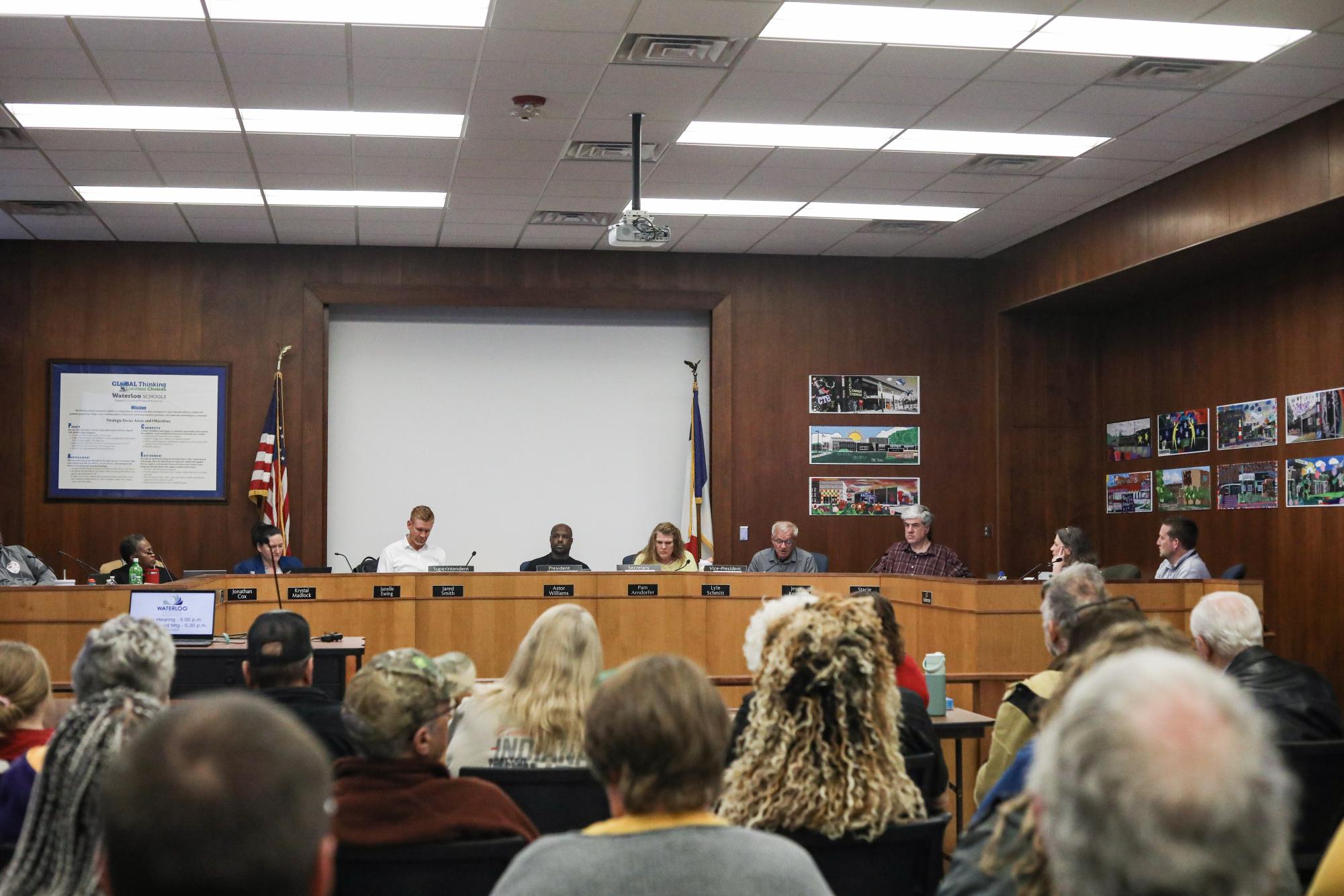
Over the past several years, the Waterloo Community School District (WCSD) has faced multiple financial pressures, including insufficient state funding, declining enrollment, increased student needs, rising inflation rates and the expiration of COVID-19 funds.
The cost of maintaining year-over-year salary and daily operations has exceeded the rate of state funding for public schools.
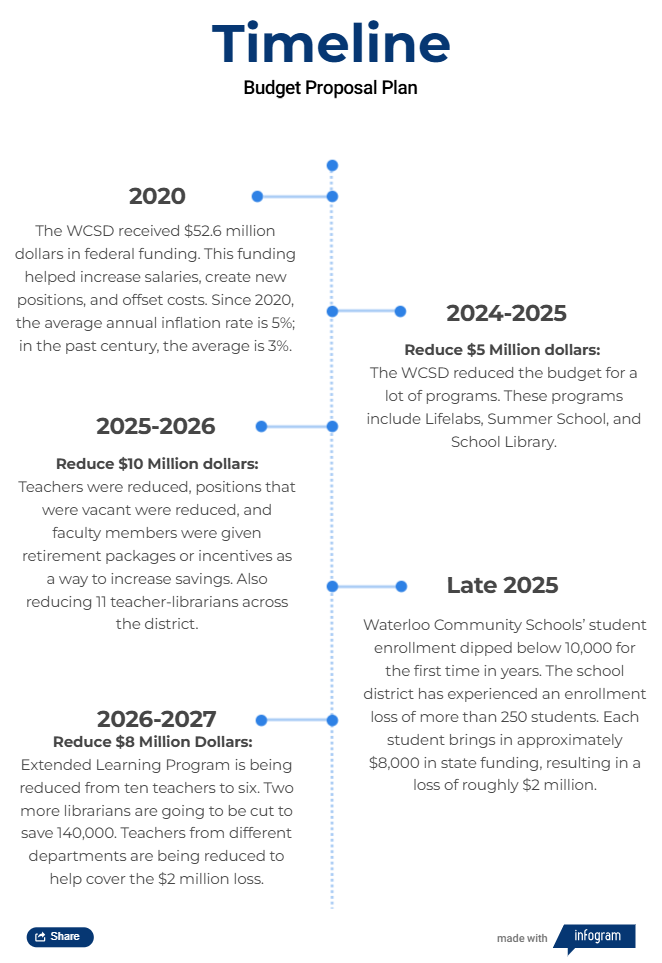
Over the past ten years, WCSD student enrollment has decreased significantly, leaving a considerable impact. This year alone, the school district has experienced an enrollment loss of more than 250 students. Each student brings in approximately $8,000 in state funding, resulting in a loss of roughly $2 million. This decline directly affects the district’s ability to fund programs, staff positions and services.
Inflation has also strained resources over the past few years. Since 2020, the average annual inflation rate has been approximately 5%, compared to the past average of 3%.
In 2020, the WCSD received $52.6 million dollars in federal COVID-19 relief funding. This funding helped increase salaries, create new positions and offset operational costs. This funding is now gone, while many of those costs remain.
As a result, Waterloo Community School District’s Leadership introduced a multi-phase budget reduction plan on March 10, 2025, led by Superintendent Dr. Jared Smith.
The budget plan has three phases: Phase one (2024-2025): Reduce $5 Million dollars, Phase two (2025-2026): Reduce $10 Million dollars, Phase three (2026-2027): Reduce $8 Million Dollars. This totals $23 Million in cuts over three years.
Smith emphasized that this situation is not unique to Waterloo.
“Budget cuts are never easy, like most school districts are going through cuts right now… There’s actually a handful of districts that are looking at closing school. I think it kind of caught a lot of school districts off guard a little bit,” Smith stated.
Teachers are an important part of every students education, which is why for the Waterloo Community School District, putting students first is a guiding principle when it comes to budget cuts. District leaders say that protecting classroom instruction has been a priority.
“With students being our top priority, we have worked hard to protect teachers and other ‘front-line’ employees who work closest to our kids on a daily basis,” said Smith at the March 10. school board meeting.
However, enrollment losses have still led to staffing reductions. For the 2024-2025 school year, the district reduced vacant positions, offered retired incentives and cut additional teaching roles.
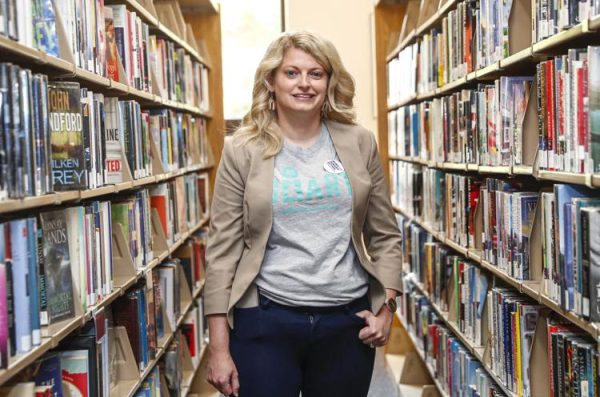
Jamie Oberheu, the Waterloo Education Association President, has spent hours since the mid-January meeting with district leadership regarding the budget. She says that union members were not fully on board with the initial proposals. “At that time, we gave them feedback over the choices that they had presented to us. Our feedback was pretty straightforward. We as a teacher union could not support any of the decisions without more input and discussion over the proposed decisions,” said Oberheu.
In addition to staff reductions, the district proposed a one-year salary freeze, which would save approximately $3.2 million. This means that instead of yearly raises, teachers will be making the same amount of money for the upcoming school year.
Even though the district proposed a salary freeze, this has not yet been accepted by the Waterloo Education Association. “As a legal right in Chapter 20, teacher unions have the right to negotiate over pay with our district and we can not accept a salary freeze without the proper channels of negotiations occurring and our members being able to ratify any decision that the negotiations team came to an agreement on,” said Oberheu.
History teacher Kaitlyn Alsaihati, one of many teachers who is currently back in school to expand her knowledge and be a better teacher, feels frustrated by a potential salary freeze.“It’s a little frustrating that I’m trying to expand my knowledge base to be a better teacher and not get rewarded,” she said. Teachers can change lanes based on the amount of education they have. Each lane change results in an increased salary. For example, a teacher on step ten in the district makes $55,034 with a bachelor’s degree. With a master’s degree, that same teacher would make $62,109. But with a salary freeze, that lane change would not be possible.
At the February 23, 2026, school board meeting, officials approved 44 staffing reductions across all levels, resulting in a total savings of about $3.74 million.
“My team and I found out the decisions that the district chose, as far as specific groups being reduced with the rest of our community on Monday night,” said Oberheu.
The cuts included certified teachers and paraprofessionals. WESP President, Amber Megivern, said that the uncertainty has been difficult for staff. “When there are a lot of unknowns it is difficult for people to know where they stand and how it affects them directly,” said Megivern.
Megivern noted that with the cuts, remaining teachers are taking on increased workloads to support students, particularly those with individualized education programs (IEPs). “We are those additional adults who work closely with students to ensure they are meeting IEP goals, staying on task within the classroom settings and advocating for their needs,” said Megivern.
One of the most controversial proposals involved cutting teacher-librarian positions. Phase one of the budget plan initially proposed reducing 11 teacher-librarians across the district.
The resources offered by librarians, including books, databases and space resources, are heavily needed by students to keep growing and learning about their passions, projects and education.
At the March 24, 2025 school board meeting, a fourth-grade student from Orange Elementary explained how important it is to have librarians at a young age. “My librarian is the best… She helps me find books that I love, and she helps me read, and she makes me have a smile every day when I show up to school,” the fourth-grade student said. “She helps us find books and find information we need to know. She helps us with looking at assignments and finding books.”
Librarians play a key role in fostering reading skills and supporting research, especially at the middle school level. It’s an important step for developing and growing as a student to get ready for high school, where classes are more challenging, reading proficiency is necessary and finding a passion is important.
The Librarian at George Washington Carver Academy, Tina Ristau said that students actively seek out books when given access. “I literally watch where kids will come in, and they run over to a table, they grab some books, or a shelf, and run back,” she said. Ristau noted how teachers won’t have the time to help students find something they will want to read, because some don’t know, and librarians are pushed to get students back in class.
Ristau explains how librarians are different from teachers. While teachers teach students how to read and help them learn that skill, librarians offer more than that. Librarians foster a love and passion for reading. “The love of reading starts when they’re little. It’s harder when you’re in middle school because by then you’re also distracted by phones,” states Ristau. According to Ristau, Orange Elementary checked out 30,000 books for the 2024-2025 school year.
Currently, Ristau is worried about the future of students, the future where librarians aren’t always in the classroom to help students, the future of students who are going into high school and don’t have those reading skills.
“She [Mrs. Bruecken] might not see the effect of it for a while, but when those kids eventually get into high school, she’s going to have to start doing more to make sure those kids do well,” Ristau.
West High Librarian Alyssa Bruecken states that, “Over 2,000 books checked out this year… We see 60-100 kids for library lunches daily. Over 30,000 log-ins on databases have been documented this year so far.” Along with this, Bruecken has given over 50+ hours towards class inquiry learning.
“There is plenty of research around the essential work of libraries in schools, and we will continue to advocate that this work stays alive for Waterloo students to have access to books, databases, inquiry skills and the countless other day-to-day needs that libraries provide students,” said Bruecken.
After already losing 11 librarians across the district, leaving only six, due to the need to offset costs, two more librarians are going to be cut to save $140,000. “All levels have been directly or indirectly impacted by the loss of a dedicated full-time librarian,” states Bruecken.
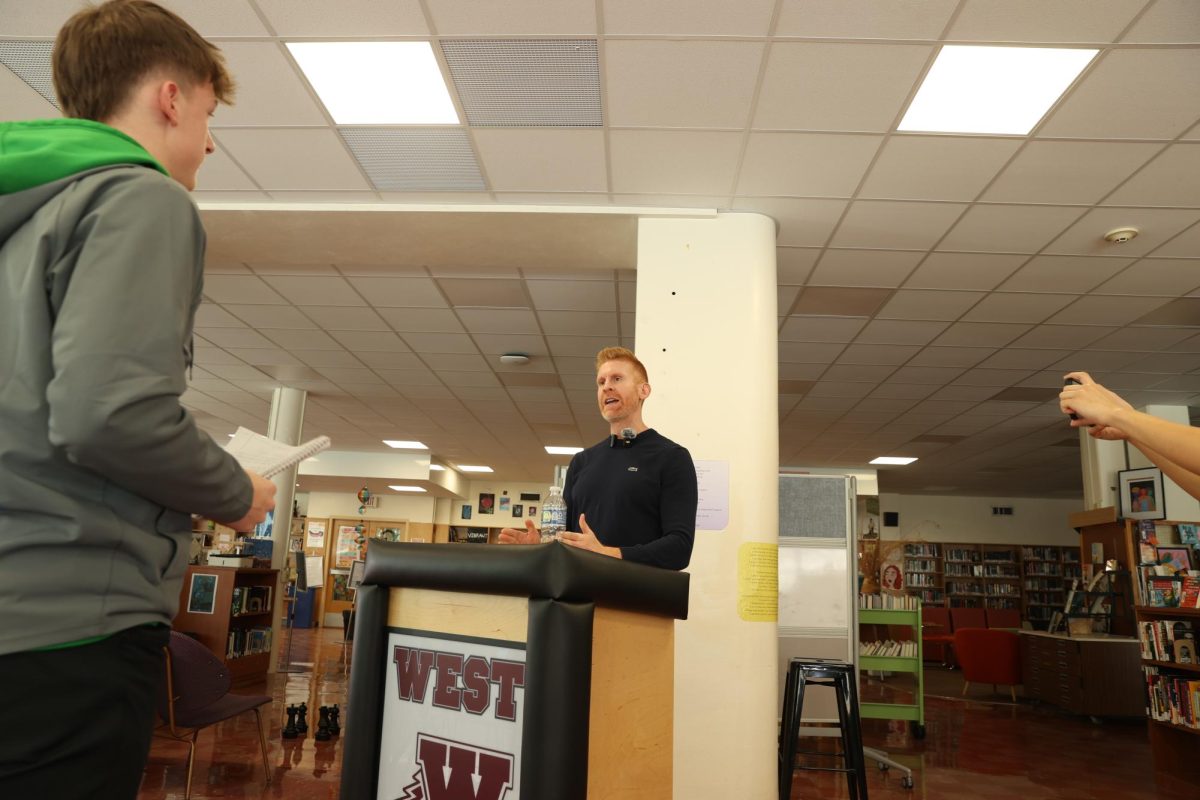
The Waterloo Community School District provides gifted and talented education programs for students in kindergarten through twelfth grade. These programs include the Expanded Learning Program (ELP) for students who show a significant gap between their intellectual ability (IQ) and their actual academic achievement, Talent Development for students who identify a strength in one or more areas and Twice Exceptional for students who are gifted in some areas while also having a disability.
Overseeing the Waterloo Schools’ gifted education program is Sherice Ortman, who is the Coordinator of Secondary Curriculum and Advanced Programs. Ortman is very proud and passionate about the program she has helped build, as she used to teach ELP at Kingsley and Lowell elementary schools before taking over as the district administrator.
The Waterloo schools also provide subject and grade acceleration for students who meet the Iowa Acceleration Scale (IAS) criteria. In high school, this is seen through access to multiple college-level courses, including concurrent, Advanced Placement (AP), Post-Secondary Enrollment Options (PSEO), allowing students to take classes at the University of Northern Iowa and the International Baccalaureate Diploma Program (IBDP).
“I knew that we had kids who wanted that level of rigor and opportunity. So it was always in our wheelhouse of kids who were advanced and critical thinkers,” said Ortman after authorizing both East and West high schools for the IB program.

These programs have helped gifted kids find a sense of direction and motivation to keep them growing. “I think people forget it’s a unique population, and they think gifted kids will be fine, and that’s not always the case. They put a lot of pressure on themselves, and sometimes they sit idle, and they kind of get to a point where they don’t want to work harder, but they think they’re supposed to,” said Ortman.
Budget cuts are reducing ELP staffing from ten teachers to six. The elementary level will have four, and the middle school will have two. Fortunately for middle schoolers, they have advanced math and ELA, and high schoolers have access to 72 college classes or the Career Center.
The budget cuts have impacted areas like coaches, instructional coaches, librarians and music. Ortman was part of the conversations about reductions, and she states that, “the district really tried to protect the classroom teachers and not cut classroom teachers and increase classroom sizes and to keep it manageable.”
“You cut $8 Million. How deep does it cut? Unfortunately, a program that I’ve worked with and am incredibly proud of and protective of was one that was cut, and so now we’re figuring out how we can be proactive and still meet the needs of gifted and talented kids in Waterloo,” said Ortman.
The district also announced cuts to music staff, reducing four teaching positions for the 2026-27 school year. These reductions would total approximately $280,000 in annual savings.
At the middle school level, music programs will drop from three teachers to two. East High will only have two certified music instructors for band, orchestra and choir. West will maintain the three certified music instructors, each for band, orchestra and choir.
The West High School band program has been one that’s been hit really hard by these budget cuts. Moving from two directors to one, Band Director Jason Dobbs said that the change has limited some opportunities, such as band lessons.
“If students have their seminars during classes I teach, I am not able to schedule their lesson during that time. With two Directors, there was usually at least one Band Director available each period to cover student band lessons out of their seminar time,” states Dobbs.
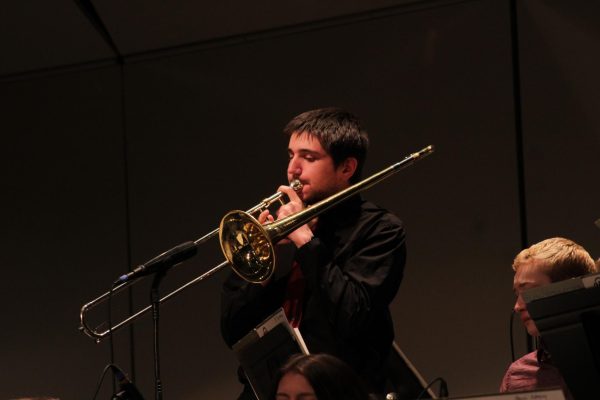
Dobbs also explains how hard it has been with one director instead of two, especially for ensembles like the Jazz Band. “I am not able to fully cover two full Jazz Band schedules as we had been able to in the past. In past years, each Director was responsible for either an advanced Jazz Band or a training Jazz Band.” Students have noticed the difference as well. Senior Dean Hempel was quick to see these changes, stating that during marching band, “There could not be a director on the field at all times watching or someone monitoring individual section time during rehearsals. Those jobs fell upon our shoulders.”
Your donation will support the student journalists of Waterloo West High School. Your contribution will allow us to purchase equipment and cover our annual website hosting costs.