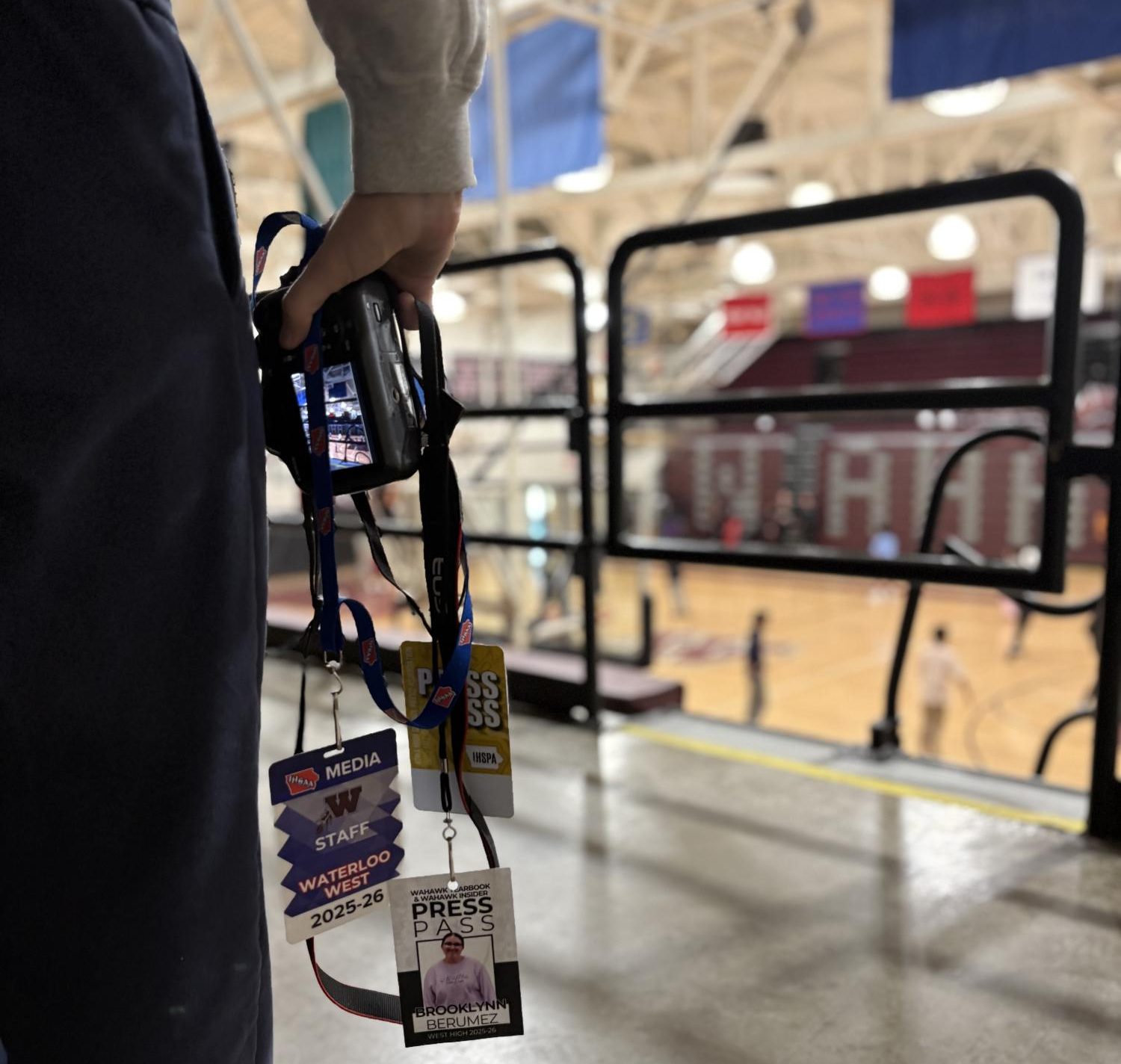
The number of photographers at West High sporting events has increased in recent years, including community members, professionals, journalism students and hobbyist photographers. Within Waterloo Schools and West High School specifically, there are currently no formal guidelines or policies outlining what photographers can and cannot do or who is permitted to photograph events. As a result, expectations have blurred between what photographers can and cannot do and who can or should be at every event.
West High Athletic Director, Tom Ulses, has expressed concerns with the rising number of photographers who attend sporting events, with student safety remaining his top priority. As athletic director, Ulses is responsible for ensuring that games run smoothly while maintaining a safe environment for athletes, spectators and staff.
Ulses explained that “before, when there weren’t really as many students, it was no big deal. You just kind of deal with the one person or the two people.” However, as interest in content creation has grown, managing those expectations has become more complicated. “All of a sudden, I got like four people walking around with cameras,” Ulses said, noting the challenge of managing space while allowing photographers the freedom to capture the game.
Ulses emphasized that his role requires him to consider the risks that others may not notice. “I don’t want to run the risk of a photographer getting run into by somebody just because they’re trying to be as small as possible against the wall,” he said. According to Ulses, some photographers have begun “putting themselves in places that were either dangerous or distracting,” raising safety concerns. These challenges, he believes, highlight a growing need for clearer expectations as more photographers attend school events.
For Kailib Fisher, the face behind OTR Studios, photography has been both a passion and point of frustration. Fisher is a 2024 West High alum and a graduating student from Hawkeye Community College, where he is earning an associates degree in digital mass media.
Content creation was not new for Fisher. During high school, he and his friends built a social media presence through YouTube. In 2025, he received a text from his younger cousin asking if he could create a mixtape during a basketball game. Fisher accepted, and from there, his interest in photography and videography grew. Encouraged by a friend from Hudson, Iowa and supported by access and equipment through Hawkeye Community College, Fisher began shooting high school athletics in the Cedar Valley.
“I shot at West a lot last year, and like, you could look back at my videos, and just like you could see me under, like, the hoop everywhere, near the stairs and all that,” Fisher said. This year, however, his experience changed as conflicts with faculty began to rise.
After photographing several basketball games at West High, Fisher decided that the West vs. East rivalry basketball game on December 6, 2025, would be his last time photographing events at West High for the foreseeable future, though he continues to photograph West High athletics at other venues. “First things first, it’s not the players’ fault. It’s not the athlete’s fault. It’s not your guys’ fault,” Fisher said.
On December 8, 2025, Fisher made a Facebook post explaining his decision to step back. “Due to unkind acts from some faculty, I have carefully decided to no longer shoot images or videos at West High going forward. Again, thank you all for your support, and I look forward to continuing out a great season,” Fisher stated.
The decision was difficult. “I love West, I would do anything for them. Kids, students will still ask me to come to the games, but it’s just, like, right now at this time, I just can’t do anything,” Fisher said. He also questioned whether expectations were consistent.
But Fisher is not alone. Kayson Cordell has been photographing sporting events for nine months after receiving a camera from his mom. He described how expectations can vary depending on the event that there is a lack of consistency from game to game.
Another student photographer, Solomon Ridgeway, has been taking photos for a year after also receiving a camera from his mom. Ridgeway shared that he has “got yelled at or, like, told to move because I’m in a certain spot on the court.” But he added that he is not always sure what those “certain spots” actually are.
Ozzy Taylor began photographing events after suffering a track injury last season and has continued developing his photography skills since then.
Although student photographers at West High find enjoyment in their work, some share that they use their camera as a way to get into games. Without clear guidelines in place, some students feel that there is confusion over access and placement, which has led to issues at sporting events.
From the athlete’s perspective, reactions to photographers vary. Freshman Pernell Grover, a guard for West High’s boys basketball team, said, “I am focused on the game, so what happens on the sidelines doesn’t really matter to me.” Another athlete and photographer, Kayson Cordell, offered a different perspective, sharing that “when they [athletes] see a camera, they just like, act different.”
Ulses noted that photography guidelines had not been a significant concern until recent months and shared that, to his knowledge, no formal policies exist. His primary concern remains keeping photographers “in areas that are appropriate for them, with the space that we have, so that they’re not in the way of the game.” While Ulses does not believe a strict policy is necessary, he stressed the importance of photographers understanding where they are allowed to be for their own safety and the safety of others. “We need to get the word out to all the people that are taking pictures, as far as like, this is where it’s okay for you to be, versus we don’t want you here at this time for a variety of reasons,” Ulses says.
In previous years, increased athletic success led to greater coverage from larger organizations. More recently, that coverage has expanded to include local and student photographers. Ulses acknowledged the value of that visibility, noting photography allows for “just the ability to capture those moments in unique and cool ways.”
Ulses expressed a willingness to work with the West High journalism program to develop clearer guidelines or policies that would help organize photographer access at sporting events. In the meantime, he hopes photographers will check with an administrator on duty to understand expectations for each event, so “that way nobody’s feelings get hurt and nobody’s toes get stepped on.”
“Now more than ever,” the need for clarity is evident. Astor Williams, Waterloo Community Schools Board President, West High alum and referee emphasized that it is “necessary to film and highlight the good things that are happening within your building, within the district.” While officiating, Williams said, “I joined in the conversation with these young people and talked about the safety aspect of it [photographing] as an official. We try to be aware, sometimes when we’re running down the court, it’s a blind eye.”
Williams acknowledged that “there are protocols that should be in place,” noting that it should be clearer which areas are off limits. Williams emphasized that photography is “a good part of the game” and that “people perform different when the lights are on.” When athletes know their efforts are being recognized, they “get into a zone,” according to Williams.
Rather than creating conflict, Williams believes a clear policy would eliminate confusion. “There needs to be a policy in place so that we’re not having these conversations to where we don’t know what can and can’t be done,” Williams said.
With Williams willing to be a part of the process and open to “all options and student opinions,” the path forward is clear. Photography belongs in school athletics, and now more than ever, clarity is needed.