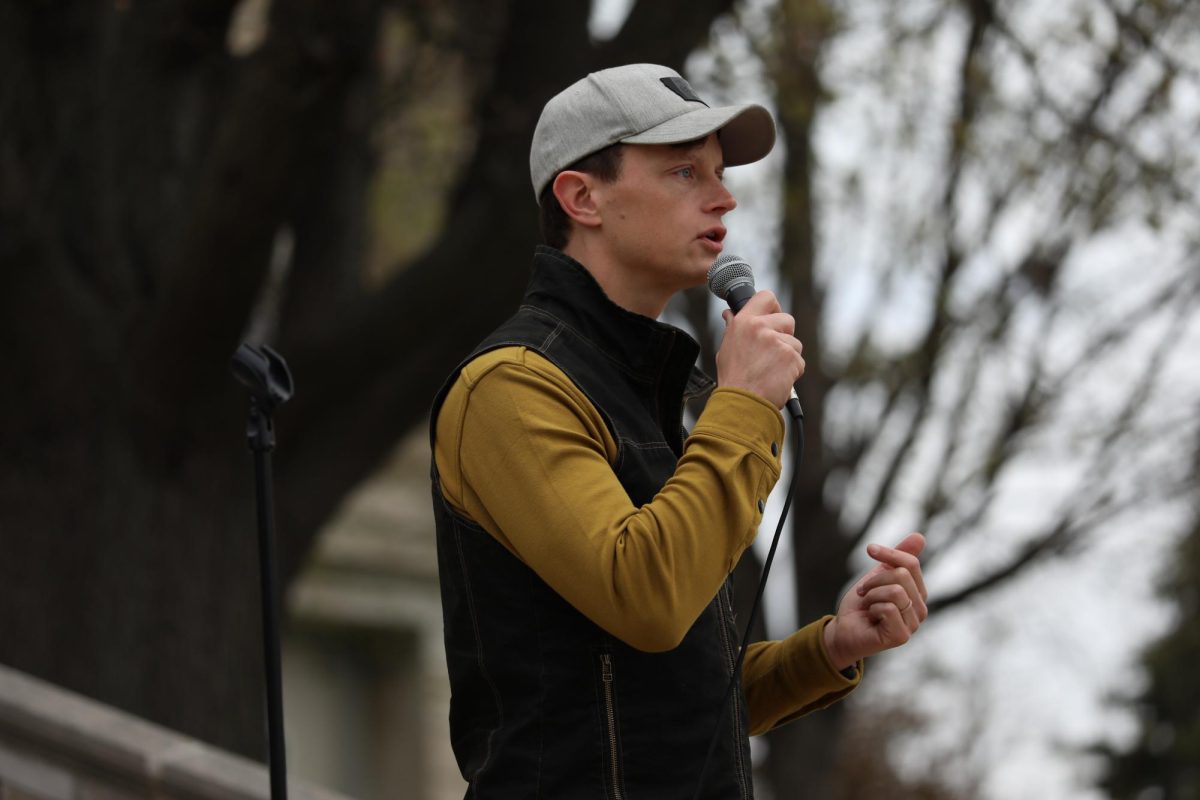


Vietnam Veteran and West High alumnus Stephen Levey used his personal experiences to explain the emotional impact and the reason for creating a painting honoring the West High veterans after the Vietnam War.
Levey graduated from West High School in 1965 and continued his education at the University of Northern Iowa. Within 30 days of graduating, he would receive a draft notice like many of his friends and classmates. Levey enlisted in the Air Force, where he would be a missile officer, manning three missiles and becoming second in command of a missile squadron in Minot, North Dakota; he was responsible for ten missiles and three nuclear bombs.
“We had 117 veterans out of my class, and we probably had 315-320 young men who graduated, so about one out of every three of us ended up in the military, drafted, and a good portion of them went to Vietnam,” Levey said.
Most veterans who served in the war were young men who didn’t have a choice, separated and estranged from friends and family. Those who survived Vietnam are now older, but every day they are still living and fighting in Vietnam. Most suffering from PTSD and alcoholism, “Alcoholism was a really big thing that they brought back as well,” said Levey.
Levey describes a friend’s experience, “One gentleman who was going through something like 15 different surgeries, he was wonderful. One of two, I think of the entire squad, who survived an attack and a battle over there (Vietnam), and he had so much shrapnel in him, and he’s to this day, still fighting some of the effects of the war.”
Additionally, Levey explained the horrifying acts done during the war, emphasizing the reality of Agent Orange, a powerful weapon used by the U.S. Military, named for the orange stripe on its barrels, during the Vietnam War to clear jungle foliage, which often had Viet Cong fighters in them. Agent Orange causes severe, long-term health issues like cancers, diabetes, birth defects and ongoing environmental contamination affecting both U.S. veterans and Vietnamese civilians.
West High, History teacher Mr. McNally states that, “The war was devastating and took a massive toll on a generation of young men. Many did not return, and many who did were left with lifelong trauma from what they experienced. War is terrifying, and it causes incredible pain and destruction for those who served, those who were caught in the crossfire and those at home.”
Looking back at Vietnam, Levey reflects on how devastating Agent Orange truly was to them. Soldiers often faced the dangers of letting the enemy come too close, which allowed the Viet Cong to suddenly attack. “It’s like a deer coming out of the ditch where the ditch isn’t mowed.” As a solution, they sprayed Agent Orange, “they would knock down 200 feet of trees along the rivers or around the bases and things.”
“If you were in that area when they were putting that out and dispersing that, they [American Soldiers] didn’t realize that, that was poison, and that was a poison that was such that it would stay with you your entire life.”
Creating the Painting
One of Levey’s friends, who recently passed away, influenced the creation of Levey’s painting.
“He came out with Prostate cancer, low-grade prostate cancer, after 21 years in the military. And then about seven years ago, that caught up to him, along with that he had an aortic aneurysm that almost killed him. He had a severe ulcer in his stomach. He got an infection from that, which destroyed his bladder, and then his kidneys went the heck on him,” said Levey. Following these battles with his health, was a cancer diagnosis. “Right after all of that, that low-grade cancer bloomed and went off the scale. He ended up with bone cancer, and he fought for five years to get through all of that before he died from the bone cancer. And that was all relating back, all those years to Agent Orange.”
However, Levey’s painting truly came into fruition as an idea for his best man, Matthew Nut. A fellow veteran pitched the idea to Levey to create a painting for Nut’s birthday at a class of 65′ luncheon. “They’d had more than a couple of cocktails, apparently, and the idea came up that they thought I should do a painting from that photograph, and we would give it to Matt in April on his birthday,” said Levey.

Levey only started to paint in 2013, doubting his ability, he would even say, “I don’t think I can do this.” To which his friend Larry would “cornball” him into doing it.
The painting was created from a photo taken by David Alball of Nut on a wall at the Vietnam Veterans Memorial in Washington, D.C. Getting plenty of publicity, the photo was published on the front page of the Waterloo-Cedar Falls Courier Newspaper (WCF), the Des Moines Register, and more throughout the state of Iowa.
Taking inspiration from a painting someone did of the Korean Wall at the Korean War Veterans Memorial in Washington, D.C. The painting would take Levey around five months to complete. “The subject matter was very personal,” Levey said. Levey highlights the six names in large print on his painting. Those six names were the six young men from Levey’s class who died 18 months later after graduating.
“I implanted those names just because I wanted them to stand out,” Levey said. The names of the individuals were spread all over the panels.
Each name on the panel was painted with respect, hand-painted, using a magnifying glass. “I got probably 90% of the names that were on that actual wall are painted, hand-painted, and all that small, and the amount of time it takes to do something like that, it’s rather intense,” Levey said.
“It was tough… those six guys on that wall who died were close friends of mine…We always wondered what would have happened if there hadn’t been a war. What would those guys be doing today? How would our relationships (be)?,” said Levey.

The Memorial
In 2017, one of Levey’s friends, Larry, would come to schedule an appointment with West High’s Principal, Dr. Andy Miehe. Sitting down with Larry, Dr. Miehe patiently listened as Larry explained the painting and the idea of starting some kind of Vietnam memorial.
He was able to accomplish this task, as seen in the auditorium foyer today. However, “It’s expanded beyond just that painting now,” said Levey, as more and more are added to the memorial.

Levey continues to paint, recently commissioning a painting for a retired colonel who served 30 years of service and three tours in Vietnam at the request of his wife. Levey painted, “an eagle with an attitude, as the way she put it.” He continues to paint this idea as the demand only increases, painting the Army, Marine Corps, Air Force and Coast Guard patches on them.

“I gave them away to the veterans I ran into. And I think I’ve given away probably 170 of those now,” said Levey.
Levey decided that he was going to give back to Veterans by giving his art. “It impresses them. They kind of go, lose their breath for a second when they see it. It’s something that’s going to be passed down to their family after I’m gone,” he said.
It’s more than a painting; Levey hopes that his artwork will help students understand that, while his classmates graduated high school in 1965, “it was in two months of graduating, that they were boarding a bus going to the Army, because they had been drafted, not their wish. We were very patriotic back in the day.”
Levey emphasized how different a time it was; high school students were being sent into war days after graduating, separating them from friends and family. “I’m hoping that people will just take a look at that [painting] and understand. It wasn’t just go over there for two years and, you know, have fun by any means. It wasn’t a clean war, it was a dirty war, a terribly dirty war,” Levey said.