
Artificial Intelligence (AI) has become increasingly common in schools, workplaces and everyday life. More recently, it has been implemented in education systems across the nation, including Waterloo Community Schools.
Students have shared concerns about the use of AI at Waterloo West High School and across Waterloo Schools as a whole.
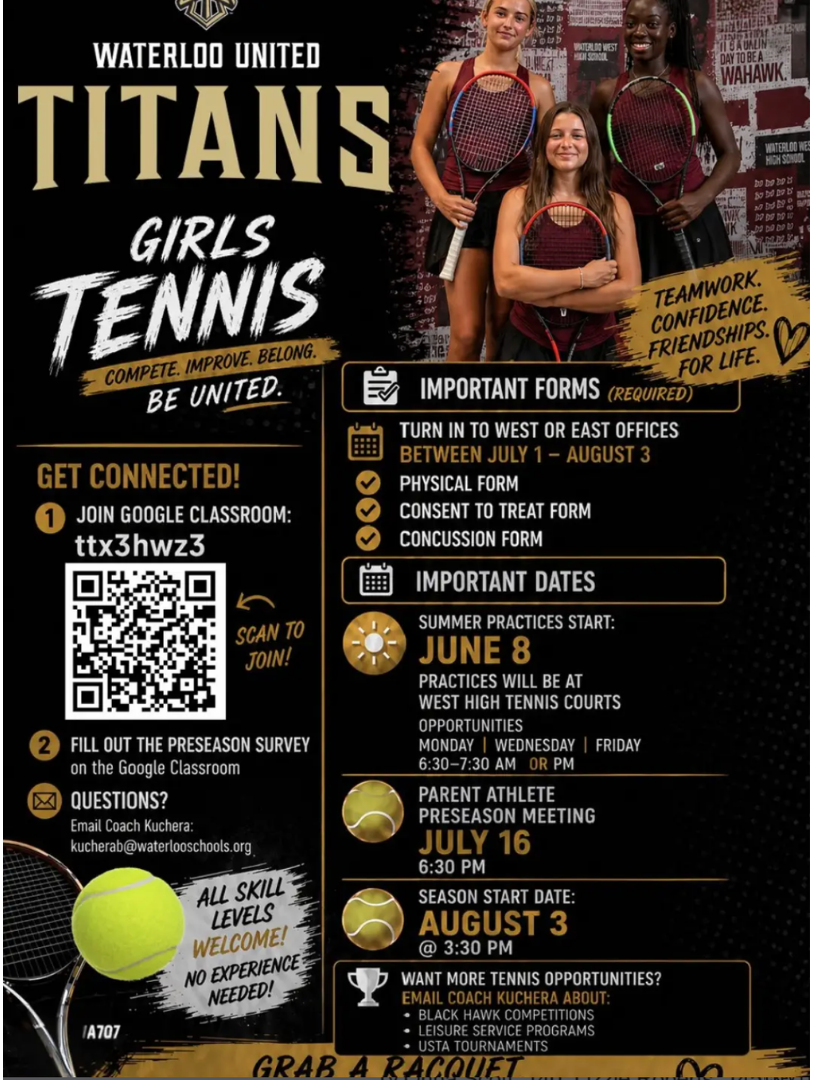
Harper Doerder, a sophomore who is heavily involved in the tennis program at West, shared her opinions on AI and a recent experience she had with it at school. “I think of AI as something that is a big problem in developing critical thinking for students, becoming a crutch to lean on, taking away jobs, and ruining the environment.” Those concerns amplified her frustration with a recent tennis poster created for the new Waterloo United branding.
The poster sparked discussion among some students, who believed AI editing altered the appearance of the athletes featured in the image. Doerder loves her coach and her team, but still felt a little upset because an image of Doerder and two other tennis players, Janet Toe and Phinleigh Buck are featured on the poster. After comparing the original photo to the final product, she felt the use of AI took away from the authenticity of the team.
“I feel like the AI post that was made about me provided a view of the tennis team that made it not genuine,” Doerder said. “I offered to make a poster or a slideshow and I was told that it was covered already, so seeing the things that covered the actual work that I was going to put in being AI felt as if the heart behind the team wasn’t being expressed.”

Girls tennis coach Brenton Kuchera explained that the decision was largely driven by time constraints and changing district policies. “There’s a lot of fine balances between what is allowed and what’s not allowed, and so rather than allow the students to start working on this one, I didn’t want them to get muddled down with the policies that are still being written, so I did this poster,” he said.
As Waterloo prepares to combine East and West High Schools into Waterloo United by fall of 2028, athletic programs have begun transitioning to the new branding. Kuchera said he used Canva’s AI features to create the poster quickly while incorporating Waterloo United colors and logos. “Canva has an AI prompt feed…we wanted to kind of minimize the West branding and try to make it more United branding,” Kuchera said. Getting this poster out was important to Kuchera so he used the AI prompt feature to get the poster made quickly and efficiently.
Students have also expressed concerns about AI being used by teachers and staff members. While some adults view AI as an inevitable part of the future, several students expressed skepticism about its growing role in education.
Senior Kyle Squire shared his thoughts on the growing presence of AI in education. “I strongly dislike generative AI, as it greatly contributes to environmental destruction, and shows a lack of human creativity,” Squire said. “As people become increasingly reliant on AI, their brains not only worsen, but their dependency can easily be taken advantage of by AI companies, through price increases, or even controlling the flow of information.”
Squire believes AI can be useful for “grunt work” or repetitive tasks, but he does not think it should be used to generate assignments, grade student work or replace critical thinking in the classroom.
Sophomore Hayden Rand also shared concerns. “I think AI has many implications in the adaptation of human knowledge, but I feel it is also negatively impacting the schooling environment by giving people easy and sometimes false information,” Rand said.

Rand, who plans to enter the International Baccalaureate program and has maintained a 4.0 GPA, says AI creates an uneven playing field when students use it to complete assignments. “AI in schools does make me upset. It’s one of those things that students can use to cheat out of essays and assignments and get a good grade while others try on their work and get the same,” Rand said.
Questions surrounding AI have also emerged in district social media content.
Junior Nolan Metz said he felt misrepresented after being featured in a “Flip the Script” social media post about his interests in music and art.
“I read the article, and it’s like, ‘Nolan uses AI for his art.’ It’s like, what the hell? I didn’t even say anything close to that,” Metz said. Metz said he was unsure how the wording changed but wondered whether AI may have played a role in the final version of the post. “I don’t even think she might have necessarily lied, but she might have put it through ChatGPT, and ChatGPT came up with that, which is scary to me. I think at the end of this, what it could have been, is she was just excited about AI, and she sees this cool person, she thinks that makes that connection,” Metz said.
This concern is not limited to students.
Nicole Goodman, the journalism adviser at West, said she also noticed significant differences between answers she provided for a district social media feature and the final published version. While the post reflected information she shared, some of the wording appeared as direct quotations despite not matching her original responses. Goodman said the experience left her questioning whether AI or other tools had been used during the writing process.
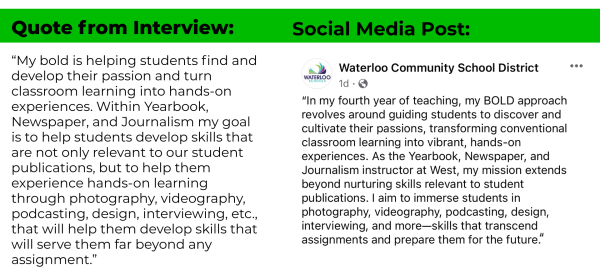
Questions about AI use in district communications grew further after a Waterloo Schools social media post published on April 11, 2026, began with the phrase “Gemini Said.” Although the post was later removed and republished without that phrase, the remainder of the caption stayed largely the same.

Katrina Hemann, the Communications Coordinator of the district, explained what happened. “That post was a scheduled draft created by a colleague filling in for our vacationing social media writer, and it was removed immediately upon posting. They obviously used AI for that post as they were probably pressured for time to get it published,” Hemann said.
Hemann said Waterloo Schools does not use AI to write social media posts but may use it occasionally as a brainstorming tool. “The use of AI should be used for the sole purpose of creating ideas and getting the spark ignited,” Hemann said. “Not for taking complete control and rewriting things.”
According to Hemann, AI has also been used to generate lists of themes and activity ideas for staff events, but only as a starting point in the creative process.
Superintendent Dr. Jared Smith has publicly supported the use of AI in education. In a recent interview with Education Insider Magazine, Smith was named one of the Top 10 School District Superintendents in the Nation. In the interview, Smith encouraged schools to embrace AI and use technology to make more informed decisions through data and digital tools.

“On AI, my view is simple. We need to embrace it. You can fight it, complain about it, or even dislike it. But if it is here to stay, why spend energy resisting something designed to help us? Our job is already hard enough. We use integrated data dashboards across the district for attendance, achievement, and operational trends, as well as digital tools in classrooms for real-time assessment and intervention. When data is tied to the plan, decisions become proactive. That is the mindset I want across every level of this organization,” Smith said.
As AI becomes increasingly common in schools, opinions among students, staff and administrators remain divided. While some view AI as a useful tool, others worry about its impact on creativity, authenticity and learning.
“We’re never going to get rid of AI,” Metz said. “What we can get rid of is the way we are acting.”