





























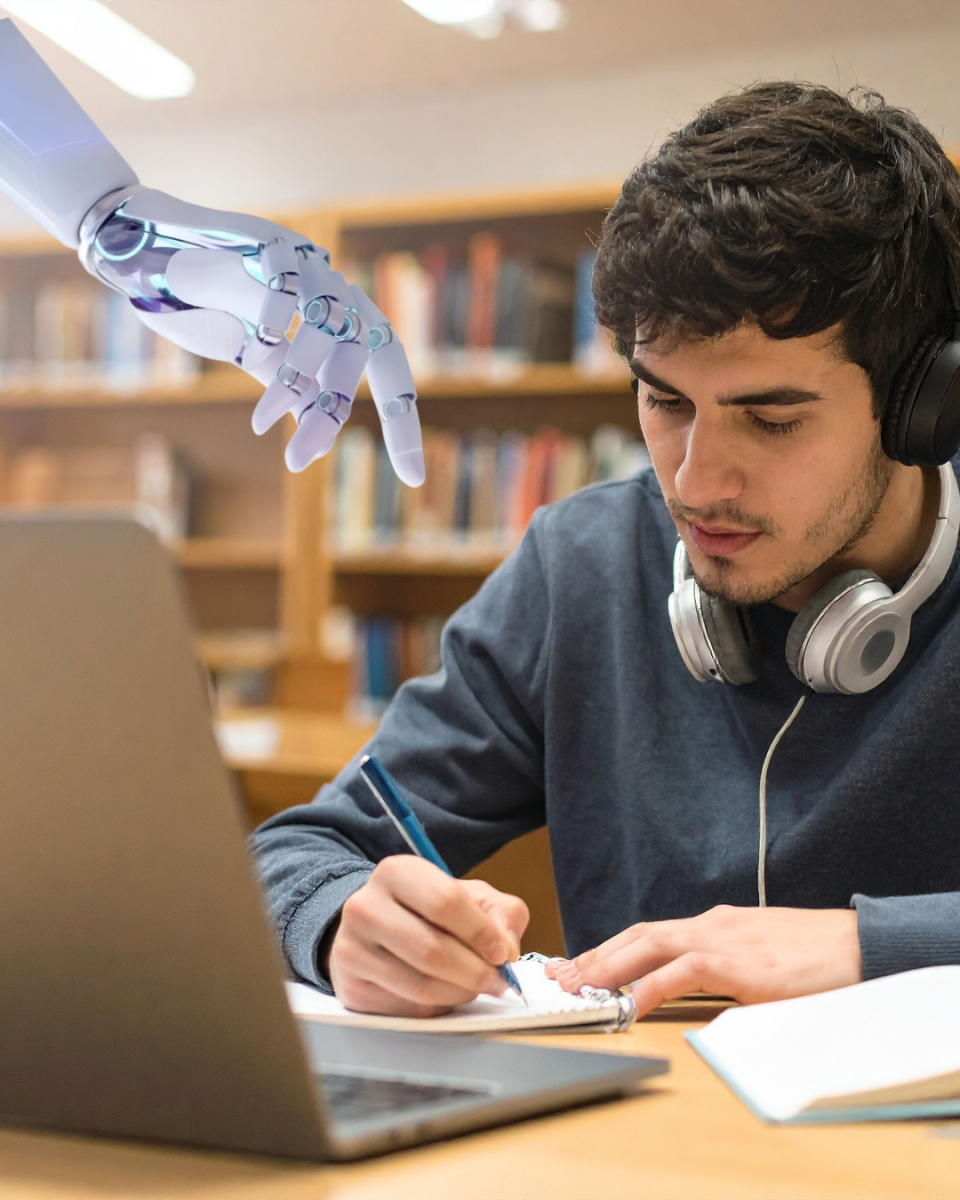
In our generation, the prominence of AI is on the rise. AI tools can assist students with a wide range of tasks; they can help brainstorm ideas, write essays, create entire artworks, and generate images in seconds. I see my peers using AI for everything. The phrase, “just chatgpt it,” is something I think all West students can agree they hear daily.
As these tools become part of daily life, questions are arising from staff and concerned parents: Is it helpful or harmful? Should it be so easy for students to access? How many students are getting away with plagiarism? It depends on how you use it.
Creative Enhancement
AI has opened up so many opportunities for teenagers, boosting creativity and allowing them to explore ideas in new ways. AI programs can create music, generate art, stories, and designs. Teens can experiment with AI, finding new ways to brainstorm and turn small imaginations into projects.
Instead of sitting in class for the entire period, stuck on what to write, AI allows for easy revisions and access to multiple versions of an idea. It’s like a collaboration for teens; it helps inspire, offer suggestions, and provide new perspectives so they can express themselves. We sent out an anonymous survey, and one student at West says, “I dont use it to do my work for me, I use it as a tool to further my understanding and learning.”
Creative Burnout
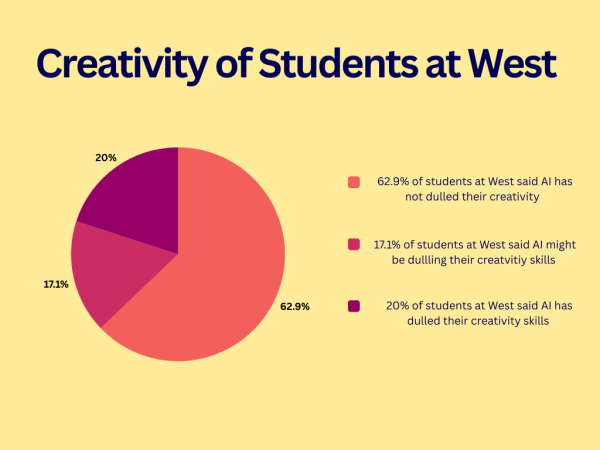
While AI can spark ideas and give inspiration, it can dull creativity when teens rely on it too much. Since AI provides answers and new ideas instantly, it’s easy to skip the critical thinking part of assignments that actually support development. A lot of people have so many great ideas, but they are so easily dulled by whatever is recommended. This takes away students’ pride; they can’t feel proud of the work they’re doing unless they’re actually doing it.
If students continue letting AI do the hard part, it instantly feels more difficult to create and brainstorm new ideas without it. I may sound like all of your teachers, but relying on it too much can make students forget what their brains are actually capable of. An anonymous student at West said, “It’s hard to be passionate and put work into things when you know AI can do it faster and probably better than you ever would. It’s just disheartening.”
The Generational Use of AI
Our generation is growing up with constant technology at their fingertips in a way nobody else has. The older generations see AI as a huge, unbelievable, new thing, while most of us see it as a quick way to finish homework. Because we’ve had such easy access to technology our whole lives, using AI feels normal, not futuristic.
With this, we’re also the first to address the challenges that come with AI. We’re trying to figure out how to use it responsibly and moderately, which is something teenagers cannot be trusted to do. It’s impossible to find the line between using AI educationally and AI doing all your work for you. This generation is just guinea pigs for what growing up with AI looks like; the way we use it now will probably shape how the next generation of teenagers uses it.
Environment and Search Engines
AI tools are starting to change the way we search for information, putting pressure on traditional search engines, such as Google. Instead of typing into the search bar and scrolling through endless articles to collect research, people want chatbots to provide them with direct answers quickly. Due to this, search engines are losing attention and clicks, which has forced them to also adapt their traditional technology.
To keep up with AI, companies are providing their own versions of AI, for example, the instant summaries that appear after a Google search. AI has created a whole new definition of searching and building research, forcing these companies to quickly revamp their companies to stay involved.
Are Teens the Only Offenders?
Around West High School, we know teenagers use AI, but what about our teachers? AI is good for our homework, but what about theirs? Teachers are using it too, and their experiences and perspectives have been just as interesting. While we turn to AI to help us find new ideas, teachers can use it for “behind the scenes” work, like lesson plans, slide show presentations, or help them explain difficult topics clearly. Some teachers love AI, while some worry that it’s giving their students shortcuts.
World History teacher Mr. Kahl often uses AI in his classroom, “AI helps me merge and summarize sources, change reading levels of things we are doing to help students understand things better, analyze student work more efficiently, and find places where students might be struggling,” Kahl said. Kahl also allows his students to use AI for certain assignments, making sure they know the specific scenarios in which it’s acceptable. He gives his students opportunities to evaluate what AI is telling them,” They seem to enjoy playing with and trying to find places where AI messes up, because that is just kind of fun while also being really useful,” Kahl said.
To contrast Kahl’s unique perspective on the use of AI, Sara Kavalier, (AP) English teacher, believes that the way most students are using it is as a substitute for thinking for themselves. “It’s not AI itself, but avoiding challenging tasks, which AI makes it easier to do, or using AI to replace critical thinking steps of assignments, will definitely lead to a downfall of those skills,” Kavalier said. If these systems continue to be unregulated, it’s helping students make poor choices and avoid work.
We all know that students have been trying to cheat on assignments for years, but AI is set up like an automatic gratification system. Hearing directly from our staff shows that AI is affecting everyone; the perspectives of teachers help show students a bigger picture of how technology is changing their classrooms.
AI in the Environment
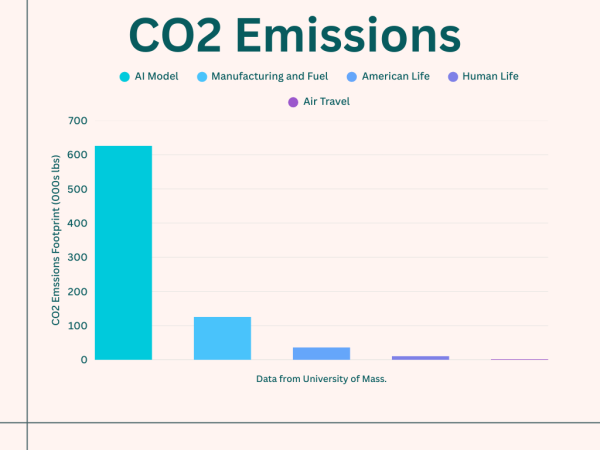
Even though AI feels like any other part of the internet, it is creating a lasting impact on our environment. AI is relying on massive inputs of data to continue answering billions of people and their burning (literally) questions in seconds, which leads to emitting many carbon emissions into the air. Currently, data centers in the U.S. take up about 1-1.5% of global electricity. That number is expected to increase to 4% in 2026, due to the use of AI agents. A single AI model can emit 626,000 pounds of CO2.
To make matters worse, the majority of the energy used doesn’t come from renewable sources. All of this new technology requires a lot of new materials and constant cooling, adding more strain on the environment. Technology can seem invisible, and many fail to comprehend how dangerous it really is, but it never fails to have real-world consequences for its users.
Impact on other Search Engines
AI tools are starting to change the way we search for information, putting pressure on traditional search engines, such as Google. Instead of typing into the search bar and scrolling through endless articles to collect research, people want chatbots to provide them with direct answers quickly. Due to this, search engines are losing attention and clicks, which has forced them to also adapt their traditional technology.
To keep up with AI, companies are providing their own versions of AI, for example, the instant summaries that appear after a Google search. AI has created a whole new definition of searching and building research, forcing these companies to quickly revamp their companies to stay involved.
Conclusion
AI isn’t going anywhere, and if it’s going to stick around, we might as well use it right. From creating creativity in classrooms, AI is shaping our generation and the way we consume information. It has the power to inspire us, make school easier, save us time, but unfortunately, it also helps us avoid thinking and take shortcuts. As students growing up with crazy new technology, we forget that we are responsible for building it’s repuation, and how our future generations will use it. AI should be used as a tool, not as a replacement for our effort. We need to use it in a way that will allow us to grow instead of keeping us back.